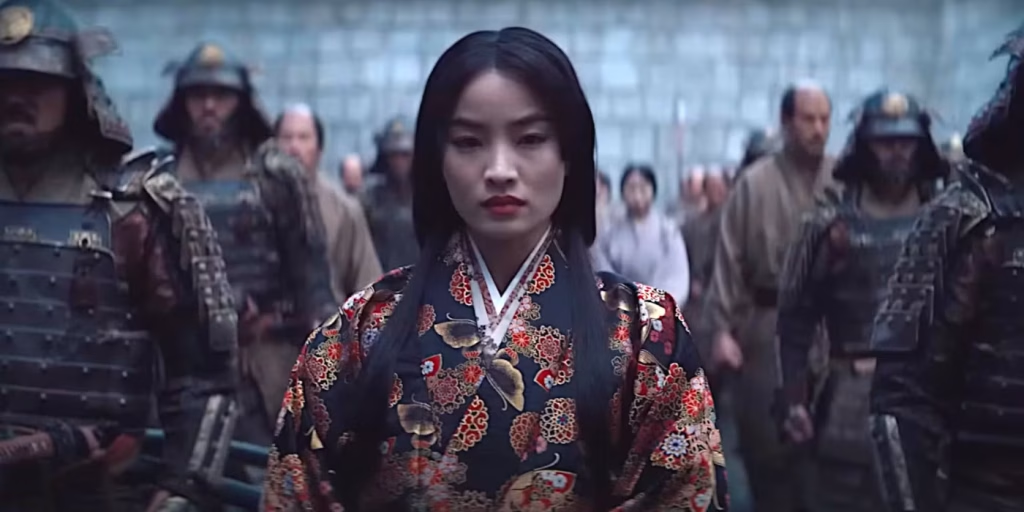
Many of you would have already seen the FX series “Shōgun” (hosted by the Disney Channel), which managed to secure its lead actor Sanada Hiroyuki the ‘Best Actor in a Drama Series’ award at this year’s Golden Globes Awards, making him the first Japanese actor to win such an award.
The same series also secured a “Best Actress” Emmy award for Anna Sawai in the role of Lady Mariko, the first actress of Asian descent to win that award, and the second actress to win an award portraying Lady Mariko (after Shimada Yoko, who won a Golden Globe in 1980 for her depiction of the same character in the original TV series).
The series itself was based on a novel by James Clavell, a British-Australian author, who spent time as a POW in Changi Prison in Singapore during WWII but who developed a fascination with all things Japanese. While ‘Shōgun’ is a work of fiction, many of its characters are based on actual historical figures.
One of those figures is Hosokawa Gracia, the model for Lady Mariko.
To look into the origins of Hosokawa Gracia, first we have to go back to mid-sixteenth century Japan, an era known as the ‘Sengoku Jidai’ (戦国時代) when much of the country was embroiled in civil war and strife. Numerous warlords known as ‘daimyō’ (大名, literally ‘owner of great private lands’) were striving for control over territory, forging and breaking alliances, fighting battles and laying siege to one another.
It was into this world that Gracia was born in 1563 (in the Japanese calendar, years are numbered according to the era of Imperial reign they co-incide with, which in this case was Eiroku 6). At this stage of her life, Gracia went by the name of ‘Tama’ or ‘Tamako’, the third daughter of the daimyō Akechi Mitsuhide, who himself was a vassal of the legendary Oda Nobunaga (one of the three great unifiers of Japan, and more about him in a future post!).
When Tama was 15, she was married off to Hosokawa Tadaoki. The Hosokawa were one of the most prestigious daimyō families in all of Japan, with aristocratic lineage going back centuries. Tama’s marriage was (according to historical records) arranged by Oda Nobunaga to strengthen his own ties with the Hosokawa, with Mitsuhide’s daughter acting as a proxy.
From all accounts, the marriage was a relatively happy one. After first living together at Shōryūji temple castle (now found in Nagaoka City in Kyoto Prefecture), they later moved to Miyazu castle, further to the north of the then capital Kyoto and located on the coast of what was then called Tango province. During this time, Tama gave birth to two children – a boy and a girl.
This relatively quiet life came to a crashing halt on the evening of June 2, 1582. Tama’s father Mitsuhide, for a variety of personal reasons, chose to rebel against Oda Nobunaga and surrounded him and his retinue in Honnōji temple in Kyoto where Nobunaga had stopped for the night. Nobunaga died during the hours-long siege, with Mitsuhide declaring himself ruler and demanding obedience from all of Nobunaga’s remaining retainers and vassals.
Mitsuhide’s rule was very short lived. 11 days after what became known as the Honnōji Incident, another of Nobunaga’s retainers, Hayashi Hideyoshi, managed to return from the west of Japan where he had been fighting on Nobunaga’s behalf. Gathering together loyal forces, Hideyoshi fought and defeated Mitsuhide at the Battle of Yamazaki.
Mitsuhide was killed fleeing from Hideyoshi’s forces and all of his lands were seized for redistribution. His remaining direct family members and vassals were caught and executed, thereby virtually wiping out the Akechi name at a stroke.
This naturally put Tama in a precarious position. While her husband and his family professed their loyalty to Nobunaga and then to Hideyoshi, Tama’s lineage put her under suspicion with many of Hideyoshi’s vassals recommending that she too be put to death. To ensure her survival, the Hosokawa decided to send Tama away into the mountains, to a small residence in the village of Midono.
Even now, Midono is a difficult place to get to, often being cut off to the outside world by snowfalls in winter. It was in this place that Tama, together with a few retainers who had accompanied her, spent her time, going so far as to shave her head and adopt a more pious lifestyle (nonetheless she did manage to have her second son while in exile).
In 1584, Hayashi Hideyoshi completed the construction of Osaka Castle and called on all loyal vassals to establish a residence there around the castle. This marked the return of Tama from exile and her re-entry into society as the ‘official’ wife of Hosokawa Tadaoki.
But Tama’s heritage meant that she remained under suspicion, something about which her husband was acutely aware. It was a rare thing for Tama to be allowed to leave the Hosokawa residence in Osaka, and so she spent most of her time behind its high walls. It was while there that she learned of this new religion called ‘Christianity’, professing a strong interest in its teachings.
It wasn’t until 1587, when Hideyoshi set off to pacify the island of Kyushu in the south of Japan, that Tama would have a chance to solidify her new faith.
Despite misgivings from some Jesuit priests in Osaka about how wise it would be to baptize someone of illustrious but notorious heritage (especially knowing that Hideyoshi was deeply suspicious of Christianity and the Jesuit order), a compromise was found by appointing one of Tama’s servants (who herself was Christian) to act as a surrogate, learning the baptism rite from the Jesuits and then performing it on Tama.
For her baptismal name, Tama chose ‘Gracia’, as in ‘one blessed by grace’.
It was around this time that Hideyoshi had issued his infamous ‘expulsion’ order, whereby all Jesuit priests were ordered to leave Japan. After returning from Kyushu, Tadaoki learned that his wife had converted to Christianity and was none-too-happy about it, and considered divorcing Gracia (a position that she also briefly entertained).
However cooler heads prevailed, with Tadaoki eventually accepting his wife’s decision after she explained it to him (another theory says it was the conversion of Tadaoki’s younger brother Okimoto and that of Gracia which brought him around sometime during 1594).
Yet strife was never far away in the Sengoku-era, and in 1595 Gracia’s eldest daughter Naga was caught up in a controversy surrounding her husband, Maeno Kagesada and his father and their lord Toyotomi Hidetsugu. Both Kagesada and his father were forced to commit ritual suicide (or seppuku 切腹) with Naga spared but forced to return to the Hosokawa.
By 1600, Hideyoshi himself was no more and an intense rivalry broke out between his successors over who would inherit the mantle of ruler.
The two most likely candidates were Tokugawa Ieyasu (the historical figure behind Sanada Hiroyuki’s Lord Toranaga Yoshii), based in the east of Japan, and Ishida Mitsunari, based at Sakamoto in the centre of Japan and closer to the capital.
Ieyasu was by far the more powerful of the two and had been a former rival to Hideyoshi. He had pledged to uphold a vow he made to Hideyoshi on his (Hideyoshi’s) deathbed, which was to look out for Hideyoshi’s young son Hideyori until he came of age.
Yet Ieyasu had not managed to survive the Sengoku-era through charm alone. He knew an opportunity when he saw one, and with Hideyoshi’s death, all cards were once again on the table.
Tadaoki was a close confidant of Ieyasu, with the two of them often consulting one another. Mitsunari, worried that his chance at power might vanish if more daimyō chose to side with Ieyasu, and considering himself the genuine successor to Hideyoshi, decided to strike before it was too late.
It was while Ieyasu was away in the east suppressing another daimyō family, a task for which he had been joined by Tadaoki, that Mitsunari made his move. Issuing an order that all daimyō families in and around Osaka were to send family members to him as hostages, Mitsunari marched to Tadaoki’s Osaka residence to demand its surrender and the handover of hostages.
As the lady in residence, Gracia faced a grave dilemma. If she gave herself over as a hostage, it would gravely weaken her husband’s position vis-a-vis Ieyasu.
He was on the other side of the country, and so there was no hope of him being able to return to lift the siege. As the daughter of Akechi Mitsuhide, surrendering would only further besmirch her name and that of the Hosokawa.
As in times past, the honourable thing to do was to commit ritual suicide, preserving both her reputation and that of her family. Only there was one major problem – Gracia was a Christian, and Christians were forbidden from committing suicide on pain of eternal damnation.
In the end, a solution was reached. Ogasawara Hidekiyo, a vassal of Tadaoki in the same residence as Gracia and in no way affiliated with Christianity, was ordered by Gracia to take his naginata pole sword and use it to pierce her chest, which he subsequently did. She was 37 years old at the time of her death.
While she had met a tragic end, Gracia’s memory was kept alive by Tadaoki. After being granted the territory of Buzen by Ieyasu (in northern Kyushu, now the land around the city of Kokura where the castle still stands), in 1601 Tadaoki requested the Jesuit priest (Gnecchi-Soldo) Organtino hold a mass for Gracia, later allowing a church to be built in Nakatsu. There mass would continue to be held in Gracia’s memory until Tadaoki’s own death in 1611.
While you could be tempted to conclude that Gracia was a victim of fate, her life was more than that. She had a strong will and was determined to forge her own path, and in doing so she made the ultimate sacrifice to defend both her own and her family’s honour.
In an era of extraordinary historical characters, she stands among them as an equal, a rare example of an outlier – a woman and a Christian – changing the historical record and in doing so creating a legend that endures to this day.
Boxer, C.B. (1986). Portuguese merchants and missionaries in feudal Japan. 1543–1640. Routledge. https://doi.org/10.4324/9781003555537
Cole, A.L. (2021). The Birth of a Martyr: The Metamorphosis of Hosokawa Tama Gracia. The Sixteenth Century Journal: The Journal of Early Modern Studies. Vol.52. No.4. The Birth of a Martyr: The Metamorphosis of Hosokawa Tama Gracia | The https://www.journals.uchicago.edu/doi/10.1086/SCJ5204002Sixteenth Century Journal: Vol 52, No 4
(N/A). (2023, December 28). 歴史ブログ 小倉城ものがたり. https://kokuracastle-story.com/2021/02/story34/
Ward, H.N. (2016, December 5). Women Religious Leaders in Japan’s Christian Century, 1549-1650. 1st. ed. Routledge. https://doi.org/10.4324/9781315233697
Subscribe now to keep reading and get access to the full archive.